I would like to take a brief look back at my time as a postgraduate at the University of Glasgow. While there I presented at a memorial conference for the centenary of the battle. I was asked to give a brief overview of the Scottish experience and participation in the fighting around the French town in the Spring of 1917. Here is what I had to say:
Scotland at Arras 1917-2017
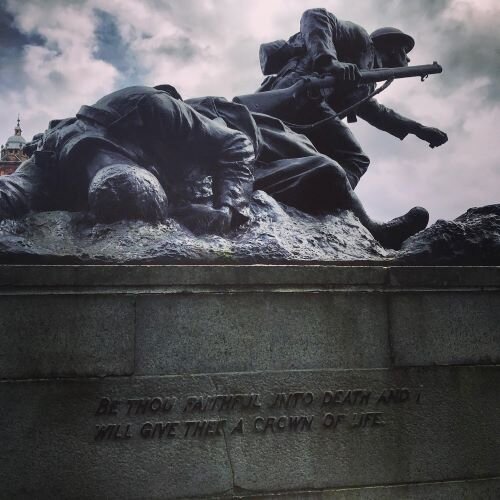
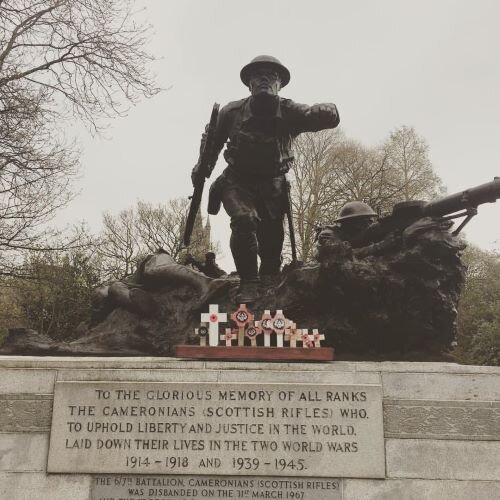
Every day that I walk to the University campus I pass in front of this building. Each day my attention is drawn to the monument directly across the street from us. The three soldiers depicted advancing, one giving covering fire from his Lewis Gun, is dedicated to the memory of the men who served in two World Wars in the Cameronians (Scottish Rifles). The Regiment, with strong attachments to Glasgow and Lanarkshire, chose to disband rather than be amalgamated in 1968. As the last remaining veterans and their families pass on an almost 300-year organization key to the identity of Scotland will disappear. Each day I pass their monument I think of the endangered past, and ways in which those of us interested in history, either professionally or as a hobby, can continue on the memory and preserve it as generations pass, and the remaining attachments disappear. This is why I will do my utmost to give you an idea of who the Scottish soldier was, and what he experienced during the Battle of Arras. To be able to cover such a broad topic in a limited period of time would be truly impossible. As on the first day of the Battle, roughly one-third of the attacking troops were members of Scottish battalions, Canadian battalions of Scottish descent, or Scots serving in non-Scottish regiments. The battalions of the British Army in the First World War give us perfect preorganized case studies from which to develop more traditional military history, as well as social history observations and arguments, as such that is how I as a Military Historian will attempt to explain Scotland’s participation in the Battle. For the purpose of explaining the presence of Scotland at the Battle of Arras, therefore, I intended not to give a narrative account of the actions of each individual battalion present, although each deserves its own 20 minutes at the podium. Instead, I want to give you, through the words of the men themselves, a description of what it meant to serve in a Scottish regiment on the Western Front in the Spring of 1917. Their story, that of the average “Jock” as he was called both lovingly and with some disdain by his fellow soldiers, is one which has been covered deeply in the past, yet remains only a footnote in the historiography of the Great War. This has been done before by historians of note including Professor Edward Speirs and Sir Hew Strachan, and for those interested, I highly encourage investigating their work, as it has helped shape recent knowledge on the topic.
From the beginning of the war in August 1914 to its conclusion in November 1918, the ranks of the Scottish battalions were filled with men from a wide array of backgrounds. Names which although are carried only in memory today fill the pages of the histories of Battles such as Arras and bring with them a sense of national and indeed international pride and identity. International due to the fact that the names of the Scottish regiments who fought at the Battle of Arras did not only include those of the illustrious Highland Light Infantry, Royal Scots, Scottish Rifles, Camerons, Black Watch, Argylls, Seaforths, Royal Scots Fusiliers, and others, but also included those such as the Royal Highlanders of Canada, the 13th, 42nd, and 73rd Battalions of the Canadian Expeditionary Force. The 4th Battalion of the South African forces was known as the South African Scottish and was clad in Murray of Athol tartan kilts. After waves of immigration, many born in Scotland or of Scottish descent were returning to Europe, while maintaining their native traditions in the Spring of 1917. These were soldiers like Donald Fraser, born in Edinburgh, and returning from Alberta with the 31st Battalion of the Canadian Expeditionary Force.[1]
The ranks of the Scottish regiments themselves had changed much since the rush to enlist in the Autumn of 1914. Most of the old regulars were long gone, the Territorial and New Army battalions had by now seen heavy service and one would be challenged to differentiate a soldier of one from the other. New arrivals to the front were no longer assuredly from the traditional recruiting areas of the many regiments. The Highland regiments, lacking the manpower in their recruitment areas traditionally looked to the Central Belt for the majority of their recruits. The Lowland regiments, in turn, looked to Northern England and London to supplement the recruits won over in the competition with the more appealing kilted units. That is not to say that the rivalry was distinctly Lowland against Highland, or Clydeside versus Morningside. Within the regiments themselves, attitudes ranged from friendly banter as in the case of the 9th Royal Scots, the only battalion of the Lothian based regiment to wear kilts being referred to as the “Dandy Ninth”, all the way towards bitter animosity. Such was the case of the 6th and 8th Argyll and Sutherland Highlanders, with the 8th coming from Argyllshire and historically predominantly Gaelic speaking, while the 6th came from Paisley and were not considered true “Highlanders”.
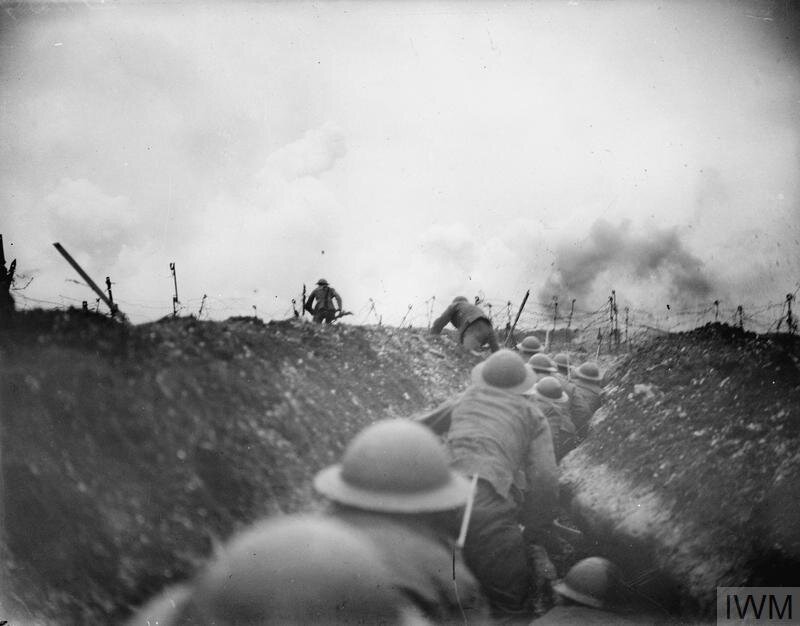
The ranks of the Scottish regiments drew men from the other side of the border as well. One soldier’s account of the war with a Scottish battalion remarks hearing a kilted soldier with a deep Lancashire accent telling another “Ah’ve been a Jock longer than thee.”[2] Soldiers such as Fred Hollingworth, an 18-year-old recruit from Manchester found himself serving in the 4th Seaforth Highlanders, as part of the 51st (Highland) Division. As his battalion advanced on the position known as the ‘Labyrinth’ on April 9th, a Canadian shouted “Good luck Jock!” which certainly got Hollingworth pondering as to how he ended up in this situation.[3] As part of a large influx of volunteers from Manchester, the 4th Seaforths had changed heavily since their 1914 establishment, which drew its manpower from Ross and Cromarty and which found 1 out of 4 soldiers speaking Gaelic as a first language.[4]
The view of the Scots varied from soldier to soldier and described battalions rather than Scots as a whole. However, as illustrated by Captain Gameson, a Royal Army Medical Corps doctor attached to the 10th Scottish Rifles, it doesn’t appear as though any of the “Jocks” much cared for the opinion of others. Gameson stated upon being transferred from the battalion that; “With some notable exceptions, whom I keep in my thoughts, they are as a race so ready to admire themselves that an outsider’s opinion passes them unheeded.”[5]
Those words ring rather true when reading letters and diary entries of the Scots preparing to enter the Battle of Arras. Robert Mackay, a Hillhead native, and Glasgow University Alumni served as a Lieutenant in the 11th Argyll and Sutherland Highlanders. He was not at all shocked when he found that all three Scottish Divisions were to take part in the initial attacks when he wrote:
“It is only when we see the enormous difficulties to be overcome that we begin to understand why three Scottish Divisions should be taken from widely different parts of the battlefield and be brought to the Scarpe where they went over, all together. It is further worth mentioning that though, like the Guards Division, we were ‘storm-troopers’ we had (1) to hold the line in trench warfare and (2) to ‘foot-slog’ in all our big moves, instead of riding in motor buses as the Guards did.”[6]
Mackay was also adamant that the press gave too much credit to the Canadians for their success on Vimy Ridge, which would not have succeeded had the Scots protected their flank during the advance. The 51st (Highland) Division is generally guilty of garnishing the most attention both during the war and after. This is generally associated with the fact that all of its battalions were kilted, the easily identifiable “Scottishness” of that uniform to non-Scottish observers, and the importance of the division in the next war. That is not to say that the Scottish battalions also did not receive negative attention. Probably the most famous is the repeated assertion by Daily Mail writer Beach Thomas, who regularly ignored mentioning the Scottish divisions when covering engagements in which they took part, and even went so far as to say of the Battle of Arras that “The Scottish troops get too much credit for their work.”[7]
Yet the feelings of personal achievement were not limited to the 51st Division. In the battalion most closely associated with the University of Glasgow, the 6th Queen’s Own Cameron Highlanders, the days of University students and staff comprising a whole company were long gone. The Soldiers in the battalion now, however, had formed a new identity around the hard-fought actions the battalion had taken part in at Loos and the Somme. Sergeant James Campbell hailed from Helensburgh and had no attachment to the University of Glasgow. By 1916 he found himself in the Battalion’s Lewis Gun section, and by Arras, he was one old the old hands and the few remaining originals of 1914. When informed of the Battalion’s role in the upcoming battle he wrote in his diary: “So it is up to the “Jocks” again, the old “fail me nevers”. One thing is certain, whatever the old Sixth captures it won’t lose again, I’ll bet. General Haldane is in command of the Sixth Corps, of which three divisions are “Jocks”, the 9th, 15th, and 51st. So the Scotchmen aren’t missing anything.”
The 6th Camerons as part of the 15th (Scottish) Division were consistently engaged almost every day in April. They found themselves fighting in places such as the Railway Triangle, Feuchy Redoubt, and Orange Hill on the 9th and 10th. On the 11th they were part of the assault on the village of Monchy-le-Preux, and although originally only intended to be the support for the assisting 37th Division, found themselves embroiled in close-quarters fighting in the town itself, all in a blinding snowstorm. Campbell describes the action when he says:
At 4 a.m. the companies formed up for attacking, the battalion headquarters being just behind them in a sunken road. The Royal Scots went over on the right, the Camerons in the centre, and the Royal Scots Fusiliers on the left, with the Argylls in reserve. The Germans had some well placed machine guns, but in spite of heavy losses the brigade got right forward, slowly, but none the less surely. The 46th Brigade were on our right and the 37th Division seemed to be all disorganized. Only one battalion, the Middlesex, did well and along with our two brigades captured Monchy le Preux and dug in on the hill beyond. […] I had the gun teams in old German dugouts but we had to leave them as the Doctor needed them as temporary dressing stations. So we lay together in the snow and tried to keep as cheery as possible. And it wasn’t easy. The Germans tried a counter attack before dusk but they caught it hot for their pains. After dark we were told that the 17th Division were relieving us during the night. About 11 p.m. we were relieved and went down through Feuchy. The snow and rain were coming down hard and fast and the wind was in or faces. And being wet through and tired out we did not enjoy the walk.”
As the 6th was finally taken out of the line for a brief spell on the 12th, their Brigade Commander and his staff were handing out tots of rum to each man, while the General exclaimed how pleased he was with “his Camerons”. Campbell wrote that he had never been so close to breaking teetotal in his whole life. Even with the acknowledgment of the Middlesex Regiment’s assistance in the attack, distinct differences are highlighted. The same article on the battle which argued the Scots were too glorified in the press ended up in the hands of many of the Cameron Highlanders days after the action. Campbell and the 6th Camerons were unconvinced on the Thomas’ arguments. Campbell wrote; “And after taking Monchy le Preux we read in the newspaper an article by that blighter Beach Thomas, talking of the capture of the village as a triumph for the English troops. He’s a liar. And he says that Scotch troops get far too much credit for their work. He’s a bloomin’ twister that man. We had iron rations again tonight to cheer us up a bit.” Even the rationed praise of Robert Mackay was bestowed upon the Camerons stating:
“I have rarely had occasion to praise the 6th. Camerons in our Brigade (tho’ we Argylls would never let an outsider say a word to us against them without getting on his top) but they can scarcely be too highly lauded, along with the Royal Scots, for their show on that day at Monchy. They had some 250 casualties in 3 days fighting, losing 6 officers killed and about 10 wounded. The stretcher-bearers had a hard time. They worked themselves off their feet.”[8]
By the end of the Battle of Arras, which we place roughly on May 16th, 1917, measurable successes had been achieved at a high cost. The British Army suffered a higher daily death rate during the Battle of Arras than at either the Somme or Ypres, and one can only speculate how the memory of this battle would have changed had it lasted as long as the other two. The 15th Division suffered 6313 casualties while the 51st suffered 4,596.[9][10] The 9th Division decided to place the memorial to its war service on the Battlefields of Arras near the Pont-de-Jour, where it remains today situated among the final resting place of those who fell serving in its ranks. The Seaforth Highlanders also placed their collective memorial to the First World War near Fampoux, the site where the 2nd Battalion was decimated and Lt. Donald Mackintosh won his VC. And yet as a battle, Arras has been lost in the shadows created by the Somme, Ypres, and Gallipoli. One of the only remaining societal attachments to the battle is in Scotland, where the number of Scots engaged, and who became casualties still impacts various communities to this day. We can only guess where the memory and study of Scotland in the First World War, and at battles such as Arras will go once the centenary is complete. We can, however, say that we helped continue the Scottish tradition by being here tonight discussing the memory and actions of the Scottish soldiers who fought and fell 100 years ago outside the French city of Arras.
[1] Fraser, Donald. The Journal of Private Fraser, 1914-1918, Canadian Expeditionary Force. Compiled by Reginald H. Roy. Nepean, Ont., Canada: CEF Books, 1998.
[2] Craig French, Friends are good on the day of battle: the 51st (Highland) Division during the First World War (Solihull, West Midlands, England: Helion & Company Limited, 2017), 136.
[3] Jonathan Nicholls and Martin Middlebrook, Cheerful sacrifice the Battle of Arras, 1917 (Barnsley, South Yorkshire: Pen & Sword Military, 2011), 94.
[4] Craig French, Friends are good on the day of battle: the 51st (Highland) Division during the First World War (Solihull, West Midlands, England: Helion & Company Limited, 2017), 98.
[5] Edward Spiers, “The Scottish Soldier at War,” in Facing Armageddon: The First World War Experienced, ed. Cecil Hugh and Peter Liddle (London: Leo Cooper, 1996), 328.
[6] Glasgow Young Scot, 20 Trongate, Glasgow, G1 5ES, United Kingdom. “A Glaswegian’s War Diary.” First World War Glasgow. June 03, 2014. Accessed May 10, 2017. https://www.firstworldwarglasgow.co.uk/index.aspx?articleid=11644.
[7] French., 151.
[8] http://www.firstworldwarglasgow.co.uk
[9] J. Stewart and John Buchan, The Fifteenth (Scottish) Division: 1914-1919 (Uckfield, England: Naval & Military Press, 2003), 141.
[10] “Battle of Arras, April 1917.” 51st Highland Division. Accessed May 11, 2017. http://51hd.co.uk/history/battle_of_arras.


 James Taub, Historian
Leave a comment